For 20 years, "getting found online" meant one thing for small businesses. Ranking on Google. You optimised your site, you wrote your content, you built backlinks, and if you did it well enough, you appeared on page one when someone searched for your service.
That model is changing fast, and most small business owners have not noticed yet.
Customers are increasingly asking AI tools like ChatGPT, Perplexity, Google's AI Mode, and Claude for recommendations instead of typing keywords into a search box. The AI gives them an answer. Maybe it mentions your business. Maybe it does not. If it does not, you might as well not exist for that customer, no matter how well you rank in traditional Google.
This is not hype. Let us look at what is actually happening, then talk about what you can do about it.
The numbers are real
Gartner has forecast a 25% drop in traditional search traffic by 2026, driven primarily by AI experiences handling queries without sending users to websites. Other analysts have flagged even bigger declines in specific verticals by 2028.
Meanwhile, the AI tools are growing fast. ChatGPT, Gemini, Perplexity, Claude and Copilot are growing traffic at 50% to 100% year on year, collectively handling a meaningful share of queries that used to go to Google.
The shift is already showing up in business data. E-commerce sites have reported a 22% drop in search traffic linked to AI-generated answers replacing traditional clicks. In B2B markets, AI-powered search is already responsible for 2 to 6% of organic traffic, with that share growing every quarter.
Translation: a real and growing slice of your potential customers are getting their answers from an AI before they ever see a list of websites.
What "AI search" actually means
Three things are happening at once, and they affect your business differently.
Google AI Overviews. When someone searches Google, they often see an AI-generated summary at the top of the page before any traditional results. The summary cites a few websites. If yours is one of them, you get traffic and credibility. If not, your traditional ranking matters less because users get their answer without scrolling.
ChatGPT, Claude, and similar AI assistants. People ask these tools direct questions. "Who is the best electrician in Perth?" "What does a small business website cost in Australia?" The AI gives an answer based on what it learned during training. If your business was widely written about online before the training cutoff, you have a chance of being mentioned. If not, you do not.
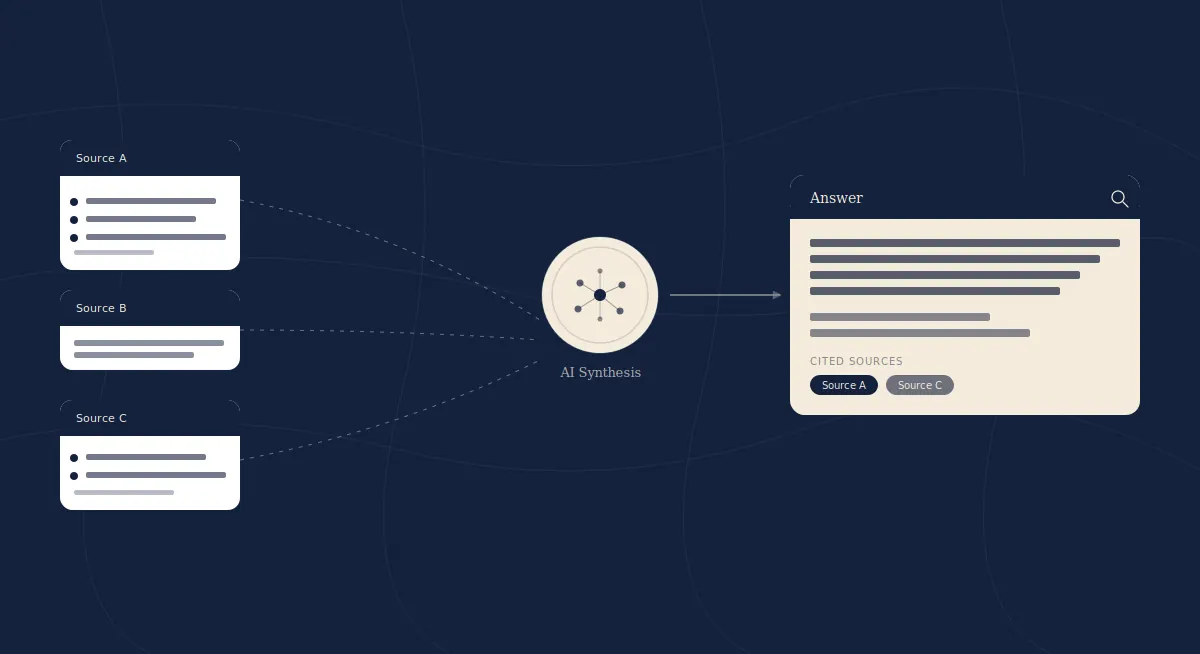
Perplexity and live-retrieval AI search. These tools search the web in real time when you ask a question, then synthesise an answer with citations. Getting cited here depends on having clear, structured, trustworthy content that the AI's crawler can read right now.
Each of these works differently, but they share one common factor. They all need to be able to read your website easily and understand what it says.
Why small businesses might actually have the advantage
Here is the good news that does not get talked about enough.
AI search systems prioritise relevance and specificity over brand size. A small business that clearly and credibly describes exactly what it does and who it serves often outperforms a large brand's generic content for specific, local, or niche queries.
Think about that. A big agency website that talks vaguely about "web design solutions" is harder for AI to confidently cite than a small studio that says plainly "we build websites for Australian small businesses, starting at $999, with a 2 week turnaround." The specific, direct content wins.
AI systems are optimising for answer quality, not for ranking signals. A well-resourced incumbent with high domain authority that publishes vague content gets cited less than a smaller brand that publishes specific, direct, data-backed answers on a narrow topic.
This is rare in marketing. Usually small businesses are at a structural disadvantage to big ones. With AI search, clarity beats budget. That is a genuine opportunity.
What you can actually do about it
Six practical things, ordered roughly by impact.
1. Make your site readable by AI crawlers
The most basic step. AI tools like ChatGPT (via OAI-Searchbot), Perplexity, Gemini, and Claude have crawlers that visit websites to gather information. If your site blocks them, intentionally or accidentally, you do not appear.
Check your robots.txt file. Make sure you are not blocking AI crawlers unless you have a specific reason to. Common blocks to look out for: GPTBot, OAI-SearchBot, PerplexityBot, ClaudeBot, Google-Extended.
If you are not sure what your robots.txt looks like, type yourdomain.com/robots.txt into your browser. Anyone can see it.
2. Add structured data (schema markup)
Schema markup is invisible code on your website that tells search engines and AI tools exactly what your business is, where it is, what it offers, and who it serves. Without it, AI has to guess from your visible content. With it, you are spelling things out clearly.
For a small business, the schema types that matter most are LocalBusiness, Organization, Service, and FAQPage. Google has stated that this structured data helps search engines parse your business details, which makes you more likely to be cited by AI platforms.
This is not optional in 2026. Every site we build at Framely ships with full LocalBusiness schema and FAQ schema as standard, because it directly affects whether AI tools understand your business correctly.
3. Add an llms.txt file
This is newer and less essential, but worth knowing about. An llms.txt file is a plain text file at the root of your domain. AI crawlers that support the protocol read it to understand which parts of your content they should focus on. Think of it as a guide for AI rather than a gatekeeper.
It is a low-effort, high-value tool for preparing your site for future AI-driven content discovery. Not all AI tools support it yet, but adoption is growing, and there is no downside to having one.
4. Write content the way AI tools actually use it
AI tools cite content that gives direct, useful answers to specific questions. They struggle with vague, generic content full of marketing language.
What works:
- Pages structured around clear questions and clear answers
- FAQ sections that anticipate follow-up questions
- Specific facts, prices, locations, hours
- Original data or examples from your own work
- Plain language without jargon
What does not work:
- "Industry-leading solutions tailored to your needs"
- Long preambles before getting to the point
- Content that hides specifics behind contact forms
- Walls of text without headings or structure
Pages that anticipate the likely follow-up questions tend to perform better in AI-driven search. If you write a page about your pricing, also answer what is included, how long delivery takes, and what happens if the customer wants changes.
5. Build mentions of your business across the web
AI tools cross-reference information across the internet to decide if a business is real and trustworthy. The more places your business is mentioned, with consistent details (same name, address, phone), the more confident AI tools become.
This means:
- Google Business Profile (we covered this in our post on what a Google Business Profile does that your website cannot)
- Directory listings (Yellow Pages, True Local, industry-specific directories)
- Mentions in local press, blog posts, podcasts
- Reviews on Google and other platforms
- Backlinks from other relevant websites
For local businesses, getting all of this consistent matters more than you might think. Ensuring your business name, address, phone number, and hours are perfectly consistent across your website, Google Business Profile, and local directories sends strong trust signals.
6. Check whether you currently appear
This takes 5 minutes and almost no one does it.
Open ChatGPT, Perplexity, and Google with AI Overviews enabled. Type queries a real customer might use. Examples:
- "Best [your service] in [your town]"
- "Who should I hire for [your service] in [your area]"
- "[Your business name]" (does AI know who you are?)
Note what comes up. Note which businesses get mentioned. If you are not in the answers and your competitors are, you now know the gap and can work on closing it.
The honest caveat
No one can guarantee your business will be cited in AI answers. There is no organic way to guarantee that your brand will show up in ChatGPT, Perplexity, or any AI search results. Anyone selling you "guaranteed AI citations" is lying.
What you can do is make your site as readable, trustworthy, and clearly described as possible, so that when AI tools choose what to cite, you are a strong candidate.
The same fundamentals apply that have always applied to good SEO. Clear content, fast site, mobile friendly, trustworthy signals, consistent information across the web. AI search rewards the same things. Businesses with a solid SEO foundation are best positioned to win AI search visibility, because both reward the same core things: relevance, clarity, and credibility.
Bottom line
AI search is not replacing Google overnight, but it is real, it is growing fast, and it is already changing how some of your potential customers find businesses like yours.
The good news is that you do not need a huge budget or a deep technical team to do well. You need a clean, fast website with proper structured data, plain content that answers real questions directly, and consistent business information across the web. That has always been the formula for good websites. The audience that benefits from it now includes both Google and the AI tools sitting next to it.
If you have not looked at your website with AI search in mind, the 5 minute test in section 6 is the best place to start. You will probably learn something useful, whether the news is good or bad.
Need a website built for AI search from day one?
Every Framely site ships with full schema markup, llms.txt, clean structured content, and a fast crawlable foundation. Built for Google, AI, and the next thing too. Get in touch for a free quote.